 |
        |
 |
Magnet TherapyHealing's Magnetic Attraction by Michael Braunstein |
|
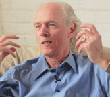
The National Institute of Health is only recently starting to get into the flow. Research on how magnets work is being conducted at several centers, including the University of Virginia. But athletes don't necessarily care how a thing works; only that it does. And they have a pretty good idea what their bodies are about. It's natural that top athletes would be attracted to "Athletes use a lot of mental imagery, visualizing the correct muscle movements for their sport," Pearson says. "They can use that same powerful tool for healing, contacting injured areas to focus on that tissue to help it in the natural healing process." Meanwhile research is continuing on the promise of electromagnetics having beneficial effect on such complaints as migraine and multiple sclerosis. The Spring 1997 issue of the Journal of Alternative and Complementary Medicine published the full results of a double blind study completed at the University of Washington. It reports "a significant improvement of patient assessed measures of bladder control, cognitive function, fatigue level, mobility, spasticity and vision for patients that had the active device." They used a magnetic pulsing device commercially available. As with most traditional therapies, magnets do not "cure" anything. Advocates claim they enhance and stimulate the body/mind's innate healing powers, doing so on a subtle energy level. In the case of magnetic therapy, the level is what Einstein described as the subtle electromagnetic force. What we don't know is if sleeping on a magnetic mattress made Einstein's hair look like that. |
|
|
For Omaha/Lincoln Sources for Magnet Therapy, Click Here. |
|
|
|
 alternative therapies. Dinnie Pearson, a Cranial-Sacral therapist with the Mind/Body Center in King of Prussia, Pa. is quoted.


What Einstein did bring us is the accepted, if not completely resolved, concept of the unified field. Now, if we need it, we can have a stable, observable phenomenon to relate to the élan vital: energy. One form or another, it is one unified field. Electromagnetism is part of that field. And it is energy that is in us and is us.
GO WITH THE FLOW
16th century English physician William Gilbert coined the word "electricity." He took the root from the Greek word "elektron," which means "amber." Amber? Because for thousands of years it had been known that amber attracts pieces of straw when rubbed by a wool cloth. Gilbert spent much of his medical career studying the effects of lodestone, or natural magnets. He didn't realize what we know now. Magnetism in metals and ore is due to the alignment of the very electrons on a molecular basis. That is why the polari ty of a magnet is always the same even if you cut it in half. The essence of magnetic attraction is billions of little "ambers" running around.
But Gilbert wasn't the first to use magnets therapeutically. Aristotle described their healing powers. Ancient Chinese used them. Galen, the Greek physician of 200 B.C. used magnets and Paracelsus was just one of the doctors who made poultices of powdered lodestone to combat arthritic pain. Mesmer mistakenly described magnets as therapeutic when in fact he was using hypnosis (Mesmerism) to effect healing.
And now magnet therapy has made a jump into the 21st Century. Recent studies at MIT show that biomagnetic therapy increases blood flow. In the late '50s, Japanese researcher Dr. Kyoichi Nakagawa described a number of conditions ameliorated by magnetic therapy. Unfortunately, American medicine is behind the curve. While the Japanese Ministry of Welfare has approved the use of bio-magnetics for treatment of several acute and chronic ailments, use in the United States is only now catching on with the general populace. The medical establishment will follow. It usually does.
Bio-magnetics apparently works by virtue of what is called the Hall Effect, first described by Robert Becker, M.D. in his research published in Science. The charged particles of the magnet, when applied to the body, penetrate to much deeper layers than a similar electric charge. The magnetic energy prompts an ionic current in the blood stream and increases circulation, and the result is stimulated healing. Newer theories also refer to electromagnetics as changing the nerve response to pain signals from receptor cells.
Becker's work is described thoroughly in his book The Body Electric. His interest is in the scientific study of that élan vital to which the classics referred. The book focuses on the science and physics of electromagnetism and its relation to the body. While it covers much of the hard science, perhaps more compelling persuasion comes from more popular sources.
FROM THE DIAMOND TO THE ROUGHWorld-class athletes rely on their mind-body connection probably more than any occupation. If their bodies aren't doing the job, they're out of one. Keeping the body in operation is essential for their life... and livelihood. It's no wonder they pay attention.
Magnets for therapy? Ask Pro Bowl linebacker Bill Romanowski.
"I'm a believer, definitely," he says. "The first time I tried them, I got pain relief. It wasn't mental. I know it wasn't mental because I know my body." He was quoted in an article in USAToday published last year.
Romanowski is just one of a growing number of pro athletes experiencing the benefits of magnetic therapy. Many pros have endorsement deals with magnet manufacturers. Ronnie Lott, former 49er, has even become an owner of a magnet therapy company.
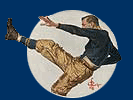
Modern Japanese have been using magnets in therapeutic wraps, insoles, mattresses and applications for decades. Ergo, it's no surprise baseball star Hideki Irabu added to the magnet trend when he joined the New York Yankees last year. Irabu currently leads the Yankees' pitching staff with the lowest ERA (earned run average.) He pitches with 40 or so magnets attached near his right arm and shoulder under his uniform. He does this to increase blood flow, keep the swelling down and alleviate pain. It seems to work for him and millions of other Americans. Sources estimate we will spend nearly 500 million dollars on bio-magnetic products this year.
The number of pro golfers using magnet therapy is also on the upswing. Back problems are nearly synonymous with the game of golf, for pros and amateurs alike. That crippling pain can ruin a game, a career. Magnet therapy seems to be a recent approach to keeping a golfer in the swing of things, literally.
"The magnets are getting a lot of credibility," Jeff Booher says in the article. "A lot of guys are swearing by them. And the great thing is that the magnets are something that can't hurt. We suggest guys try them." Booher is a physical therapist who travels with the PGA Tour.
Steve Atwater, seven-time Pro Bowl strong safety for the Denver Broncos agrees.
"I don't know what it is, but it works," says Atwater. "I figure it can't hurt me, and it may help me."
Be well.
Michael Braunstein is Executive Director of Heartland Healing and certified by the American Council of Hypnotist Examiners in clinical hypnotherapy. He graduated from the Los Angeles Hypnotism Training Institute and was an instructor at the UCLA Extension University for 11 years.
Heartland Healing is devoted to the examination of various alternative forms of healing. It is provided as a source of information and not as medical advice. It is not meant as an endorsement of any particular therapy, either by the writer or by Heartland Healing Center, Inc.
© 1997- Heartland Healing • All Rights Reserved.
Read Our Disclaimer | Privacy Policy
